Diamond guide
Shop like an expert.
Learn the secrets of the 4Cs of diamond grading to ensure your diamond selection delivers peak quality and unmatched value.
1
Cut
The cut determines how a diamond interacts with light.
Of the 4Cs, cut has the largest effect on a diamond's sparkle, brilliance, and overall beauty. A superior cut can make a smaller stone radiate with captivating presence; a poor cut can leave even a large diamond looking dull.
Cut grading is usually defined only for round brilliants. For other shapes, proportion and symmetry still matter — we check every stone before it's set.
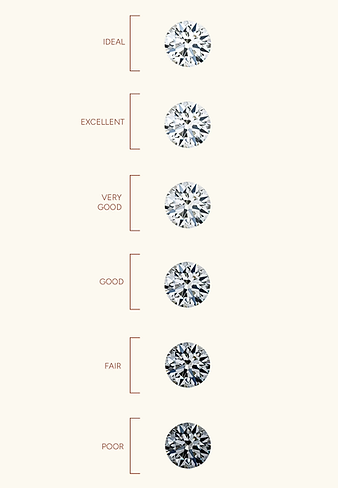
Scale
- Excellent
- Maximum brilliance, fire, and scintillation.
- Very Good
- Near-excellent sparkle at a lower price.
- Good
- Still beautiful; subtle light-return loss.
Tip: If budget is tight, keep the cut grade high and flex on color or clarity — the eye reads sparkle first.
2
Color
Color grading evaluates how close a diamond is to complete colorlessness.
The scale runs from D (completely colorless) to Z (noticeably yellow or brown). The most prized diamonds are nearly colorless — grades D through F — and offer a pristine, pure appearance.
Even minor color variations significantly impact value. Fancy-colored diamonds (blues, yellows, pinks) are graded on a separate scale and priced on a manual quote.
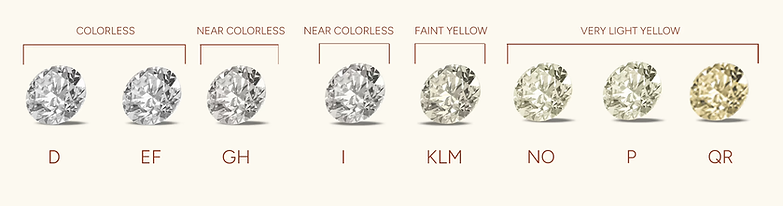
Scale
- D – F
- Colorless. Our standard recommendation.
- G – J
- Near colorless; face-up white in most settings.
- Fancy
- Colored diamonds — quoted manually within 72 hours.
3
Clarity
Clarity measures the tiny natural imperfections inside the stone.
Inclusions and blemishes are viewed under 10× magnification. Grades span from Flawless (no visible inclusions or blemishes) to Included (imperfections clearly visible to the naked eye). Fewer inclusions mean greater brilliance.
For lab-grown diamonds, VS1 to VVS2 grades are eye-clean and excellent value. VVS1 stones are rare and require a manual quote within 72 hours.
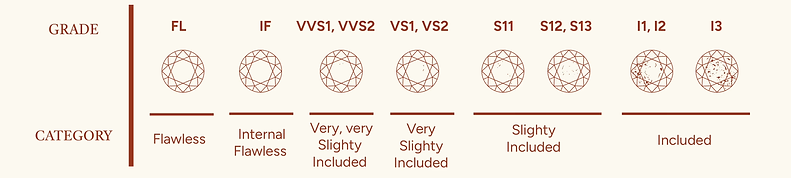
Scale
- VVS1
- Extremely rare — manual quote within 72 hours.
- VVS2
- Virtually flawless under magnification.
- VS1 / VS2
- Eye-clean, excellent value.
4
Carat
Carat is the measurement of a diamond's weight.
One carat equals 200 milligrams (0.2 grams). But carat alone doesn't determine visual size or beauty — cut, shape, and setting all affect how large a diamond looks on the finger.
Diamonds above 3 carats are priced on a manual quote. We source as close to your requested size as possible and confirm the exact stone before billing.
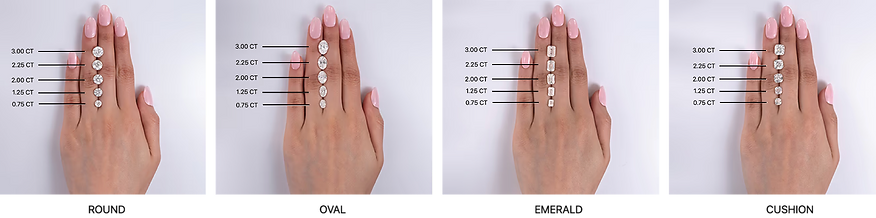
Scale
- Up to 1 ct
- Most engagement rings; instant pricing.
- 1 – 3 ct
- Statement stones; instant pricing.
- 3 ct and above
- Manual quote within 72 hours.
Tip: A well-cut 1.5 ct often looks larger than a poorly-cut 2 ct. Ask us — we'll show you the difference.
+
Shape
The geometric outline of the stone — it changes the feel more than anything else.
Round brilliants are the most common and return the most light. Fancy shapes like oval, pear, cushion, emerald, and marquise each have their own character and price adjustment.
Shape is also the most personal of the 4Cs — there's no 'best.' When in doubt, share a reference image and we'll guide you.
Scale
- Round, Princess
- Classic brilliance.
- Oval, Pear, Marquise
- Elongated, finger-lengthening.
- Emerald, Asscher, Radiant
- Step-cut drama.
- Heart, Cushion
- Soft, romantic edges.
Still deciding?
Every dropdown in our design form has an "I'm not sure" option. Share a reference image, pick what you know, and we'll guide the rest.
Start your design